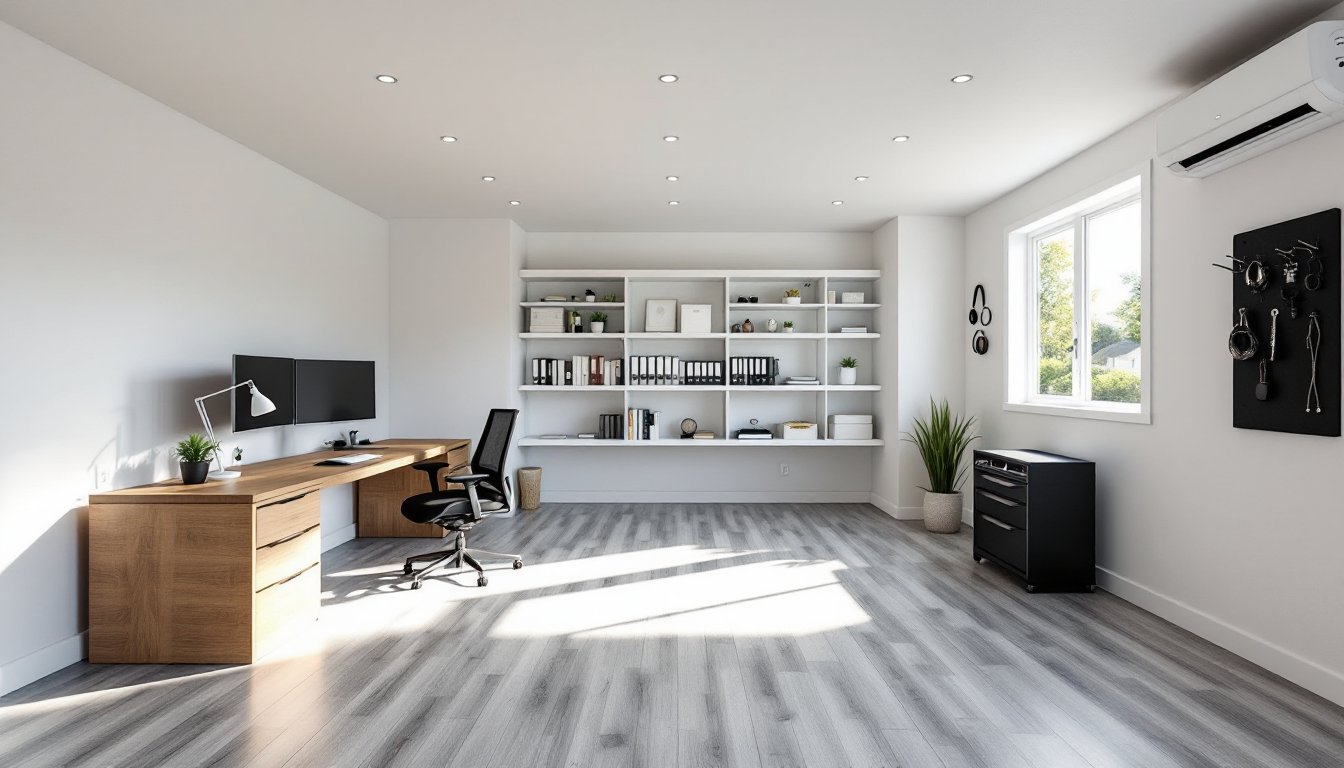
Converting a garage into a home office isn’t just a pandemic leftover, it’s become one of the smartest ways to reclaim underutilized square footage. With remote and hybrid work sticking around, homeowners are ditching the cluttered two-car bay for a dedicated workspace that doesn’t bleed into the dining room. The bones are already there: walls, a roof, power. What’s missing is insulation, drywall, decent lighting, and climate control. Done right, a garage office conversion can add functional space without the cost and complexity of a full addition, though it’s not without permitting, structural, and HVAC considerations.
Table of Contents
ToggleKey Takeaways
- A garage office conversion provides separated, distraction-free workspace while leveraging existing foundations and framing, making it more cost-effective than building a full addition.
- Proper planning is essential—assess floor levelness, insulation needs, permit requirements, and parking alternatives before starting your garage office project.
- Insulation, climate control via mini-split systems, and dedicated electrical circuits (at least two 20-amp circuits) are non-negotiable upgrades for a functional, comfortable workspace.
- Expect total costs between $5,000–$15,000 for DIY-heavy work or $15,000–$30,000+ when hiring contractors, with permits and HVAC typically representing the largest expenses.
- Maximize the converted space with strategic desk placement away from doors, wall-mounted storage, layered lighting, and reliable internet infrastructure like Cat6 Ethernet cable.
- Budget an extra 10–15% for unexpected issues such as water damage, outdated wiring, or floor imperfections that only become visible during renovation.
Why Convert Your Garage into a Home Office?
A garage offers something most other home spaces don’t: separation. It’s physically apart from bedrooms, kitchens, and family traffic, which matters when you’re on back-to-back video calls or need focused, uninterrupted work time. Unlike repurposing a spare bedroom, a garage conversion doesn’t cannibalize existing living or storage space, assuming you’ve got somewhere else to park.
From a value standpoint, garage conversions typically cost less per square foot than building an addition because the foundation, framing, and exterior walls already exist. You’re not pouring a slab or raising rafters. But, resale impact is mixed. Some buyers prize the extra workspace: others want the parking and storage back. If future flexibility matters, design the conversion to be reversible, avoid permanently removing the garage door frame or sealed floor drains.
Practically, garages tend to have high ceilings (often 8–10 feet or more), which gives room for overhead storage, better lighting, and a less cramped feel than a basement nook. Most are wired with at least one 120V circuit and have access to the main electrical panel, making it easier to add dedicated circuits for computers, printers, and task lighting. Just don’t assume the existing wiring is adequate for a full office build-out, many garages run on a single 15-amp breaker shared with exterior outlets.
Planning Your Garage Office Conversion
Before tearing out shelving or ordering drywall, take stock of what’s legal, practical, and structurally sound. Not every garage is conversion-ready, and skipping the planning phase leads to costly mid-project surprises.
Assessing Your Garage’s Suitability
Start with the floor. Most garage slabs are poured with a slight slope (typically 1/4 inch per foot) to drain water toward the door. That’s fine for cars, not desks. You’ll need to level the floor with self-leveling compound or install a subfloor system with shims. Check for cracks, oil stains, or moisture issues, standing water or efflorescence (white mineral deposits) signals drainage problems that must be addressed before anything else.
Next, inspect the walls and framing. Garages are typically framed with 2×4 studs on 16-inch centers, same as interior walls, but they’re often uninsulated and sheathed only in OSB or plywood. If your garage shares a wall with living space, that wall is likely insulated and finished: the exterior walls won’t be. Look for any signs of rot, pest damage, or missing sheathing before you cover it up.
Permits and codes vary widely by jurisdiction, but most municipalities require permits for garage conversions that include electrical, HVAC, or structural changes. Even if you’re not moving walls, adding new circuits or a mini-split system usually triggers a permit. Check with your local building department early, some areas have setback rules, fire-rated wall requirements, or egress window mandates if the space could be considered habitable. If your garage is detached, you may also need to meet separate building codes for accessory structures.
Finally, consider parking and storage. If you’re giving up a two-car garage, where will the cars go? Where will lawn equipment, seasonal gear, and tools live? A partial conversion, walling off one bay, might be a better compromise. Outdoor sheds, overhead garage racks in remaining bays, or a carport addition can offset the lost storage, but factor those costs into your total budget.
Essential Upgrades for a Functional Office Space
A functional office needs more than a desk and a lamp. Garages were built to house vehicles, not people, so expect to invest in insulation, climate control, electrical, and finishes.
Insulation and Climate Control
Insulation is non-negotiable unless you enjoy sweating in July and freezing in January. Most garage walls and ceilings are uninsulated. For walls, R-13 fiberglass batts (for 2×4 framing) or R-15 rock wool are standard and affordable. If you’re in a cold climate or want better soundproofing, consider R-19 or higher in 2×6 walls (if you have the depth). Don’t forget the ceiling, use R-30 to R-38 batts or blown-in cellulose if there’s attic space above. If the garage has a flat or cathedral ceiling, you may need rigid foam or spray foam to hit code-minimum R-values without losing headroom.
The garage door itself is a thermal weak point. You can insulate it with foil-faced polyiso panels (available in kits) or replace it with an insulated sectional door rated R-12 to R-18. Alternatively, frame a new wall inside the door opening and finish it like the rest of the office, this is common when the goal is a permanent conversion and parking isn’t needed.
For climate control, extending your home’s central HVAC is often cost-prohibitive and may exceed the system’s capacity. A ductless mini-split (heat pump) is the go-to solution, it provides heating and cooling, installs with minimal wall penetration, and runs on a dedicated 240V circuit. Expect to pay $1,500–$4,000 installed, depending on BTU capacity and brand. A window AC unit plus a space heater is cheaper upfront but less efficient and noisier. If you go that route, make sure your electrical panel can handle the added load.
Electrical upgrades are almost always needed. At minimum, install at least two dedicated 20-amp circuits, one for general outlets and task lighting, another for computers and electronics. Use GFCI-protected outlets if any remain near the former garage door or exterior. Add overhead LED shop lights or recessed can lights (4–6 fixtures depending on square footage) and task lighting at the desk. If you’re running new wiring, conduit, or a subpanel, hire a licensed electrician. DIY electrical work may void your homeowner’s insurance and fail inspection.
Finish walls with 1/2-inch drywall (5/8-inch if fire rating is required on shared walls). Tape, mud, and sand seams, then prime and paint. For flooring, luxury vinyl plank (LVP) over a vapor barrier and foam underlayment is durable, water-resistant, and forgiving over less-than-perfect slabs. Engineered hardwood or laminate also work, but they require a flatter subfloor. Carpet adds warmth and sound damping but shows wear in high-traffic areas and traps dust.
Design Ideas to Maximize Your Garage Office
Once the infrastructure is sorted, layout and design determine whether the space feels like an office or a glorified storage closet.
Desk placement matters. Position your desk perpendicular to the main wall or in an L-shape to maximize usable surface area. Avoid putting your back to the door, it’s distracting and makes video calls awkward. If the garage has windows, place the desk to one side of the window, not directly in front, to avoid glare on screens.
For storage, use wall-mounted shelving, pegboards, or slat walls to keep floors clear. Overhead shelving above the desk or door is ideal for items you access infrequently. A filing cabinet or rolling cart fits under most desks and keeps documents within arm’s reach. If you kept the garage door in place, consider a murphy desk or fold-down worktable that stows when not in use.
Soundproofing helps if you’re near a street or share a wall with laundry or mechanical rooms. Add acoustic panels, thick curtains, or sound-dampening foam to walls. Seal gaps around doors and windows with weatherstripping. A solid-core door (rather than hollow-core) cuts noise transmission significantly.
Lighting should be layered: overhead ambient lighting (LED panels or recessed cans), task lighting (desk lamp or under-cabinet LED strips), and natural light if windows allow. Garage conversions often lack windows, so consider adding one if the exterior wall allows and local codes permit. A 36-inch-wide window provides natural light and satisfies egress requirements in some jurisdictions, though cutting through siding and framing is a job for a skilled DIYer or contractor.
For tech infrastructure, plan for more outlets than you think you need, four to six duplex outlets along the main wall isn’t overkill once you add monitors, chargers, a printer, and desk accessories. Run Cat6 Ethernet cable if you need reliable, high-speed internet: Wi-Fi extenders work but add latency. A small patch panel or wall-mounted rack keeps cables tidy.
Budgeting and Cost Considerations
Garage office conversions vary widely in cost depending on size, existing conditions, and finish level. A basic 200–300 square foot conversion typically runs $5,000–$15,000 for a DIY-heavy project, or $15,000–$30,000+ if you’re hiring out most trades. National garage conversion cost averages for 2026 reflect inflation in materials and labor, especially for HVAC and electrical work.
Break down your budget into these categories:
- Insulation and drywall: $1,500–$4,000 (DIY) or $3,000–$7,000 (contractor)
- Flooring: $800–$3,000 depending on material and square footage
- Electrical: $1,000–$3,500 for new circuits, outlets, and lighting (licensed electrician recommended)
- HVAC (mini-split or extension): $1,500–$5,000
- Windows or door replacement: $500–$2,500 per opening
- Permits and inspections: $200–$1,000+ depending on jurisdiction
- Finishes (paint, trim, hardware): $300–$1,000
If you’re comparing costs or need contractor estimates, tools from HomeAdvisor and similar platforms can give region-specific ballparks. Keep in mind that lumber, drywall, and insulation prices fluctuate with market conditions, and coastal or urban markets skew higher.
DIY can cut labor costs by 40–60%, but don’t skimp on permits or licensed work for electrical and HVAC. A failed inspection or code violation discovered during resale can cost far more than hiring a pro upfront. Budget an extra 10–15% for surprises, old wiring that needs replacement, hidden water damage, or a subfloor that’s worse than it looked.